Tax Deduction Tracker Canva Template 3: Your Financial Command Center
Let’s be honest. For most creative professionals, entrepreneurs, and small business owners, the word “taxes” carries a certain weight. It’s not the filing itself that causes the most stress, but the frantic, last-minute scramble for receipts, the mental gymnastics of categorizing expenses from six months ago, and the nagging fear that you’re missing deductible costs. This annual chaos is where good intentions meet disorganized reality. The solution isn’t more willpower; it’s a better system. Enter the Tax Deduction Tracker Canva Template 3, a purpose-built tool designed to transform your financial record-keeping from a year-end headache into a seamless, ongoing habit.
A Design Built for Clarity and Consistency
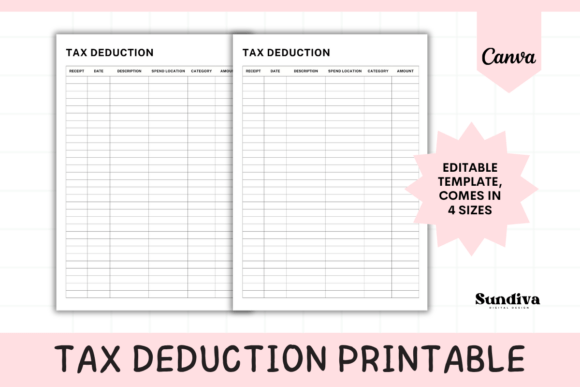
Unlike overly complex financial software or cluttered spreadsheets, this template embraces a philosophy of elegant simplicity. Its visual personality is clean, professional, and utterly functional. The layout is structured around a clear grid, using a modern sans serif typeface that ensures immediate readability. This isn’t a decorative display font; it’s a workhorse typeface chosen for its legibility at various sizes, which is critical when scanning columns of data. The overall style leans into minimalist design principles, with ample white space that prevents visual overwhelm. This intentional breathing room is a design strategy in itself—it reduces cognitive load, making the act of logging an expense feel less like a chore and more like a quick administrative tick. The appeal lies in its uncluttered professionalism, making it suitable for everyone from a freelance graphic designer to a content creator managing multiple income streams.
Where This System Truly Shines: Beyond the Spreadsheet
The true value of the Tax Deduction Tracker Canva Template 3 is its versatility as a design asset within your broader business ecosystem. It’s not just a standalone document; it’s an integrated component of your operational brand identity. Consider how it fits into your workflow:
- For the Marketer and Entrepreneur: Use it to track ad spend, software subscriptions, and contractor payments. The consistent formatting creates a reliable dataset that makes quarterly reviews and ROI analysis straightforward. Its professional appearance means you could even share a redacted version with a financial advisor without hesitation.
- For the Creative Professional and Crafter: Material costs, studio rent, shipping supplies, and platform fees are all deductible. Logging them in real-time with this tracker turns a chaotic pile of receipts into a clear narrative of your business operations. The included columns for "Spend Location" and "Category" are particularly useful for identifying trends in your spending.
- For the Blogger and Publisher: Track expenses related to content production—stock photo licenses, website hosting, email marketing services, and home office deductions. The template’s structure helps you build the habit of daily logging, which is the key to accurate records. It functions as a core part of your editorial design toolkit, just for finances.
This tracker influences more than just your tax preparation; it impacts your brand’s financial health. By providing a consistent format for recording expenses, it supports better visual hierarchy in your financial data. You can quickly scan the "Category" column to see where your money is going, creating an immediate understanding of spending patterns. This consistency fosters a sense of professionalism and control, which can positively influence your perception of your own business and the decisions you make.
Practical Guidance for Integration and Use
Getting the most out of this template involves a few thoughtful steps, moving beyond simple download to active implementation.
- Evaluate Your Project Fit: This tracker is ideal for individuals and small teams who need a clear, visual system without a steep learning curve. If your business has highly complex, multi-currency transactions, you might need to adapt it, but for the vast majority of solopreneurs and creatives, its simplicity is its greatest strength.
- Master the Edit in Canva: The template’s power is unlocked through Canva. You can easily adjust colors to match your brand identity, change the font pairing if you have a specific style guide (though the default is excellent for readability), or add your logo. The ability to edit across US Letter, Half Letter, A4, and A5 sizes means you can create a version for your desk and a condensed one for your planner.
- Establish a Routine: The template is a tool; the habit is the engine. Set a daily or weekly time block—perhaps 10 minutes every Friday afternoon—to log expenses. Treat it like updating your calendar. The intuitive layout makes this quick, and over time, it becomes second nature.
- Leverage the Columns for Insight: Don’t just fill in the blanks. Use the "Description" field for brief notes that will jog your memory later. Periodically, sort your digital log by "Category" to review your spending. This transforms the tracker from a passive record into an active budgeting and planning tool.
Remember, this is a digital product—a PDF with a Canva link. You will not receive a physical item. You need a free Canva account, and using a computer is advised for the best editing experience. The product is the key to a streamlined system, but the implementation is where the real value is created.
A Final Note on Financial Confidence
Ultimately, the goal of any organizational system is to reduce anxiety and increase control. The Tax Deduction Tracker Canva Template 3 achieves this by applying thoughtful, user-centric design to a universally dreaded task. It provides the structure so you can focus on your creative work or business growth, secure in the knowledge that your financial records are clear, organized, and ready for tax season. It’s a practical, no-nonsense design asset that serves a fundamental business need, proving that good design isn’t just about how things look, but how they help us function.