Design Professional Book Covers with Editable Canva Templates
For self-publishers and content creators, the journey from a written manuscript to a polished book involves a critical visual step: the cover. A book cover is more than decoration; it is the primary marketing asset, the first handshake with a potential reader. It must communicate genre, tone, and quality in a single glance. However, for many creating 100-page interior notebooks, diaries, or journals, investing in custom cover design can be a significant hurdle. This is where a practical, template-based approach becomes invaluable, offering a bridge between a great idea and a professional final product.
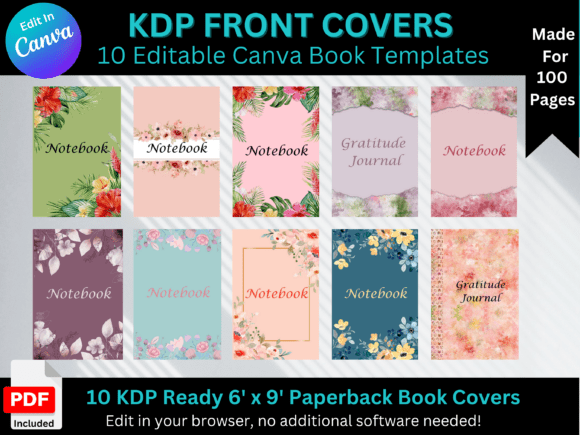
A collection of Canva Editable Book Front Covers, specifically designed for 6 x 9 inch paperback books with 100-page interiors, addresses this need directly. These are not generic stock images but structured design assets. Each template is pre-sized with the correct dimensions and bleed for Amazon KDP, eliminating the technical guesswork that often stalls publishing projects. The visual personality of such a bundle typically leans into timeless elegance—think floral motifs, balanced compositions, and clean typography. This style carries an inherent appeal of sophistication and care, suggesting to the buyer that the interior content receives the same thoughtful attention.
Where Template-Based Design Excels
The real-world value of these editable templates extends across several creative and commercial domains. For the entrepreneur launching a line of guided journals, consistency is key. Using a single bundle allows for the creation of a cohesive series where each cover shares a common design language—perhaps a recurring serif font for titles or a consistent color palette—building instant brand recognition. A blogger repurposing content into a printable notebook can leverage a floral template to align the product with their established brand identity, ensuring it feels like a natural extension of their digital presence. Similarly, a small business owner creating a custom planner for clients can add a layer of professionalism that reinforces their brand's quality.
The influence on perception is profound. A well-chosen template with modern typography and a harmonious layout directly impacts how the book's content is perceived. It establishes visual hierarchy, ensuring the title is legible and prominent, the author name is clear, and any supporting text is well-integrated. This clarity builds trust. A reader scanning Amazon is far more likely to click on a cover that looks polished and intentional, which translates to better engagement and, ultimately, conversion. The template acts as a foundation for this professionalism, providing a tested structure for readability and aesthetic appeal.
Practical Guidance for Selecting and Customizing
Choosing the right template from a collection requires a strategic eye. Begin by evaluating the project's fit. Is the journal for a serene wellness niche or a vibrant creative audience? A template with soft watercolor florals and a delicate script font suits the former, while one with bold botanical patterns and a strong sans serif typeface may better match the latter. Always consider the template's "personality" and ensure it communicates the correct emotion for your content.
Once selected, the customization process in Canva is where the template becomes uniquely yours. Here are key steps to consider:
- Typography and Font Pairing: Most premium templates will include a suggested font pairing—often a display font for the title and a complementary sans serif or serif font for subtitles. You can swap these, but maintain the established hierarchy. If the template uses a handwritten font for a tagline, ensure it remains legible at thumbnail size.
- Color and Imagery: Use Canva's tools to adjust the color palette to match your brand. You can also replace or remove graphic elements. If the floral design is too dense, simplify it. The goal is to make the cover your own while retaining the template's professional structure.
- Readability Checks: Always view your design at a small size (like an Amazon thumbnail) to test readability. Ensure the title stands out clearly. This is a crucial step for web design and digital marketplace success.
Integrating Templates into Your Publishing Workflow
For the seasoned self-publisher, these templates are not a shortcut but a tool for efficiency. They solve the dimensional challenge for specific interior page counts, a common pain point. The included print-ready PDF files for the 100-page interior specification ensure that the spine width and cover layout will be accurate for printing, removing a layer of technical complexity. This allows you to focus your creative energy on interior design and content quality.
From a brand strategy perspective, a library of Canva Editable Book Front Covers becomes a reusable design asset. A content creator can maintain a consistent look across multiple publications over time, strengthening their author or brand identity. For commercial projects, such as creating notebooks for sale, the templates provide a scalable way to produce professional designs without starting from scratch each time. It’s a practical application of modern design tools to meet the real-world demands of publishing and product creation.
Ultimately, the power of a well-structured template lies in its ability to democratize professional design. It provides the scaffolding—a correct layout, thoughtful typography, and balanced composition—upon which you can build your unique vision. By leveraging these editable assets, you ensure your book makes a strong first impression, communicates its value effectively, and stands confidently on the digital shelf.